By Sarah-Jayne Duryea, Principal Psychologist, Happy Minds Psychology
The Modern Face of Family
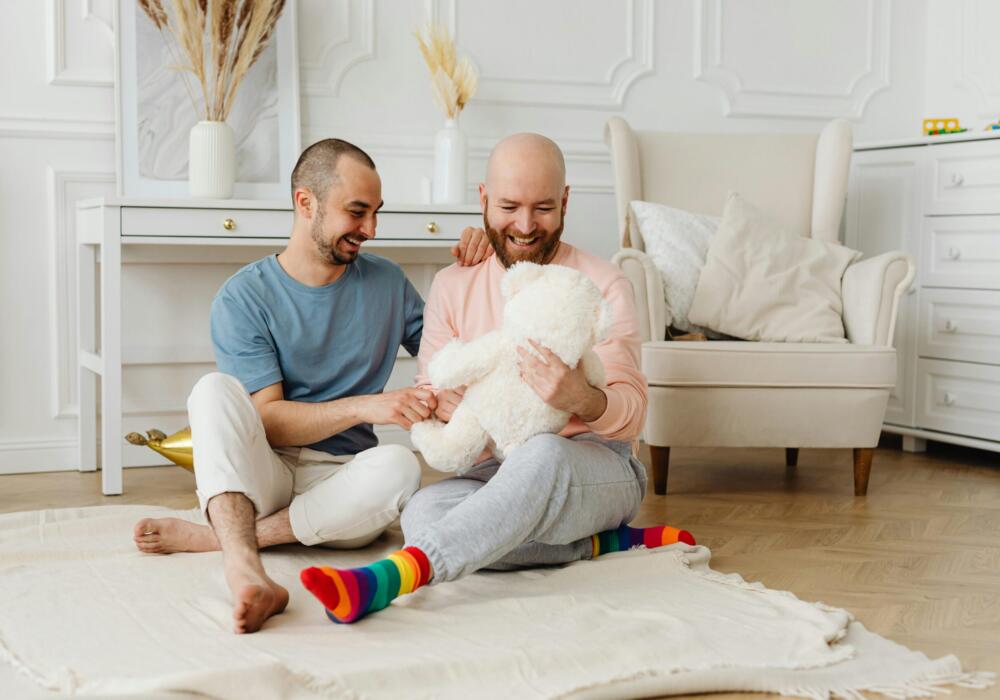
When you picture a family, what do you see? For many, the old image of a mother, father, and children still comes to mind. But families today come in countless forms — single parents, blended families, donor-conceived children, and increasingly, children raised by two dads through surrogacy.
For male couples who long to become parents, surrogacy offers a clear and compassionate path. It allows two men to create, nurture, and raise a child who is deeply wanted and intentionally brought into the world.
How Surrogacy Works for Two Dads
Surrogacy involves a woman (the gestational carrier) who carries a pregnancy for intended parents. In most modern arrangements, the surrogate is not genetically related to the child — the embryo is created using an egg donor and one (or both) of the dads’ sperm.
This process enables gay couples to experience biological parenthood, with one dad genetically connected to the child and both equally recognised as legal and emotional parents once parentage is transferred.
“Don’t Children Need a Mother?”
This is a question often asked of gay fathers — sometimes with genuine curiosity, sometimes with judgement. But decades of research across multiple countries now provide a clear answer:
Children do not need a mother and a father — they need loving, responsive, stable caregivers.
Let’s look at why.
Parenting is About Presence, Not Gender
Parenting isn’t a set of gendered tasks; it’s a collection of human ones — soothing, guiding, teaching, loving, and protecting. Two dads are just as capable of offering warmth, security, and structure as any other parenting duo.
Research consistently finds that parental quality — the ability to be emotionally available, attuned, and supportive — is the strongest predictor of a child’s wellbeing.
As Golombok et al. (2014) showed in their longitudinal study, children born through surrogacy displayed no differences in emotional or behavioural adjustment compared to naturally conceived peers.
Reference: Golombok, S., et al. (2014). Developmental Psychology, 50 (12), 2524–2534.
Outcomes for Children Raised by Two Dads
The largest body of evidence on two-dad families comes from the Centre for Family Research at the University of Cambridge.
Imrie & Golombok (2020) found that children raised by gay fathers through surrogacy are securely attached, emotionally well-adjusted, and thriving. Parenting quality and family cohesion were just as high — and sometimes higher — than in mother-father households.
Reference: Imrie, S., & Golombok, S. (2020). Current Opinion in Psychology, 37, 17–21.
Cognitive & Social Development
A 2018 study found no differences in cognitive ability, peer relationships, or social competence between children of gay fathers, lesbian mothers, and heterosexual parents.
Reference: Golombok, S., Mellish, L., et al. (2018). Child Development, 89 (2), 607–619.
Growing up with two dads often fosters empathy, open-mindedness, and strong social awareness. Children learn early that love and family come in many shapes — and that diversity is something to be celebrated, not hidden.
Attachment and Emotional Bonds
Children in two-dad surrogacy families show secure attachment to both fathers. These relationships are often marked by exceptional emotional closeness, likely due to the intentional effort and planning required to become parents.
Reference: Imrie, S., et al. (2020). Developmental Psychology, 56 (8), 1341–1353.
Both dads typically share caregiving equally — feeding, bedtime routines, school drop-offs — and report deep satisfaction in their parenting partnership. Their children, in turn, display confidence, security, and strong emotional literacy.
Psychological Wellbeing
Across dozens of studies, including Farr, Forssell & Patterson (2010), researchers have concluded that parenting quality — not parental gender — determines child outcomes.
Reference: Farr, R. H., Forssell, S. L., & Patterson, C. J. (2010). Applied Developmental Science, 14 (3), 164–178.
In fact, many gay father families report lower levels of inter-parental conflict and higher levels of shared responsibility than the general population. Their deliberate family-building process fosters a high degree of cooperation and intentionality — qualities that benefit their children profoundly.
Reference: Feugé, E., Blanchard, M., & Godbout, N. (2019). Frontiers in Psychology, 10, 2728.
Family Identity and Resilience
Openness and Pride
Children raised through surrogacy in two-dad families typically grow up with an open narrative about their conception. Parents who speak early and positively about their child’s story create resilience and pride.
Reference: Blake, L., et al. (2016). Fertility and Sterility, 106 (6), 1503–1509.
These children learn that their story began with extraordinary love and collaboration — a donor who gave an egg, a surrogate who gave time and care, and two dads who give everything else for a lifetime.
Coping with Social Bias
Although discrimination can occur, the evidence shows that two-dad families are raising children who are emotionally equipped to navigate it. Supportive school communities, inclusive representation, and family openness all serve as buffers.
Reference: Patterson, C. J., & Riskind, R. G. (2020). Journal of GLBT Family Studies, 16 (1), 1–19.
What About the “Maternal Role”?
The idea that a woman’s presence is necessary for nurturing or emotional balance is outdated and unsupported by research. Children benefit most from secure attachment figures, not from a parent of each gender.
A “maternal role” is a function — one of comfort, sensitivity, and responsiveness — and those capacities are human, not female. Two dads can, and do, embody them every day.
Moreover, as Susan Golombok (2020) writes in Modern Families: Parents and Children in New Family Forms:
“The traditional view that children need both a mother and a father has been replaced by a more inclusive understanding: children need loving parents — regardless of their gender.”
Voices from the Research
In interviews, children of two dads through surrogacy often express pride and comfort in their family structure.
One 9-year-old in Golombok’s study said simply:
“I have two dads who both tuck me in and both love me. That’s all that matters.”
Another child added:
“People sometimes ask who my mum is, but I just say I have two dads and they’re awesome.”
These candid statements mirror what the data shows — that love and security matter infinitely more than parental gender.
The Role of the Surrogate and Donor
The women who assist in surrogacy are honoured participants, not hidden figures. Their contribution is valued and acknowledged, but it doesn’t translate into an ongoing parenting role.
Many surrogates describe the experience as “helping to make a family complete.” (All Love Surrogacy, 2024). Egg donors and gestational carriers provide essential biological roles, but the daily parenting — the laughter, boundaries, hugs, and homework — belongs to the dads.
Why This Matters for Policy and Practice
As psychologists, counsellors, and policymakers, we must base our understanding of family wellbeing on evidence, not ideology.
The evidence is now overwhelming:
- Children raised by two dads are as happy, healthy, and well-adjusted as those in any other family form.
- There is no developmental need for a female parent figure.
- Intentional, inclusive parenting leads to secure attachment and thriving children.
- Legal systems should ensure equal access to surrogacy, parentage recognition, and support services for all family forms.
The Takeaway
Surrogacy enables two dads to bring children into the world through compassion, science, and profound intention. Their families challenge outdated assumptions and expand our understanding of what love looks like in practice.
Every bottle fed, every bedtime story read, every scraped knee comforted — these are the moments that define parenthood.
Children don’t need a woman to parent. They need love, stability, consistency, and connection. And two dads can give all of that — and more.
References
Blake, L., et al. (2016). Gay father surrogacy families: Relationships with surrogates and egg donors, and parental disclosure of children’s origins. Fertility and Sterility, 106 (6), 1503–1509.
Farr, R. H., Forssell, S. L., & Patterson, C. J. (2010). Parenting and child development in adoptive families: Does parental sexual orientation matter? Applied Developmental Science, 14 (3), 164–178.
Feugé, E., Blanchard, M., & Godbout, N. (2019). Parenting and co-parenting in gay father families through surrogacy: A systematic review. Frontiers in Psychology, 10, 2728.
Golombok, S., et al. (2014). Children born through reproductive donation: A longitudinal study of psychological adjustment and parent–child relationships at ages 3, 7, and 10. Developmental Psychology, 50 (12), 2524–2534.
Golombok, S., Mellish, L., Jennings, S., Casey, P., Tasker, F., & Lamb, M. E. (2018). Adoptive gay father families: Parent–child relationships and children’s psychological adjustment. Child Development, 89 (2), 607–619.
Imrie, S., & Golombok, S. (2020). Children with gay fathers: A new frontier for family psychology. Current Opinion in Psychology, 37, 17–21.
Imrie, S., et al. (2020). Gay fathers through surrogacy: Attachment security, parent–child relationships, and children’s psychological adjustment. Developmental Psychology, 56 (8), 1341–1353.
Patterson, C. J. (2017). Parents’ sexual orientation and children’s development. Child Development Perspectives, 11 (1), 45–49.
Patterson, C. J., & Riskind, R. G. (2020). To be a parent: Issues in family formation among gay and lesbian adults. Journal of GLBT Family Studies, 16 (1), 1–19.
Golombok, S. (2020). Modern Families: Parents and Children in New Family Forms. Cambridge University Press.